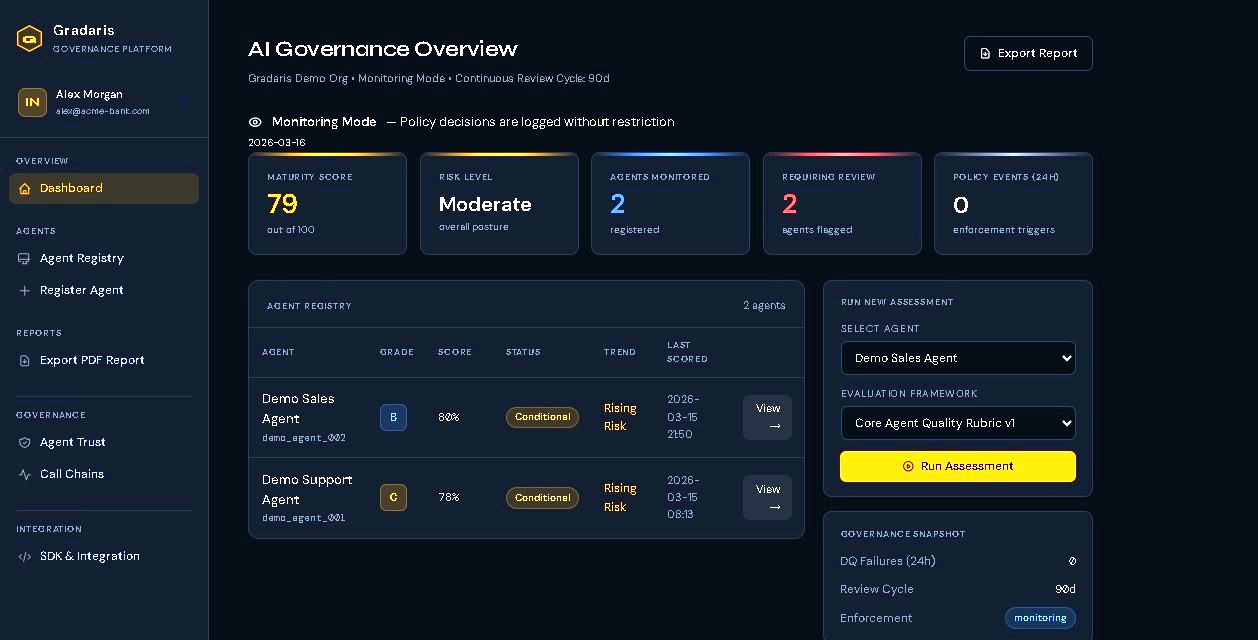
Register, assess, and certify every AI system with verifiable Trust IDs, auditable evidence, and public trust validation aligned to the EU AI Act.
No credit card · 2 minutes · Real governance record
Live control plane showing AI system registry, governance scoring, evidence status, and certification workflow.
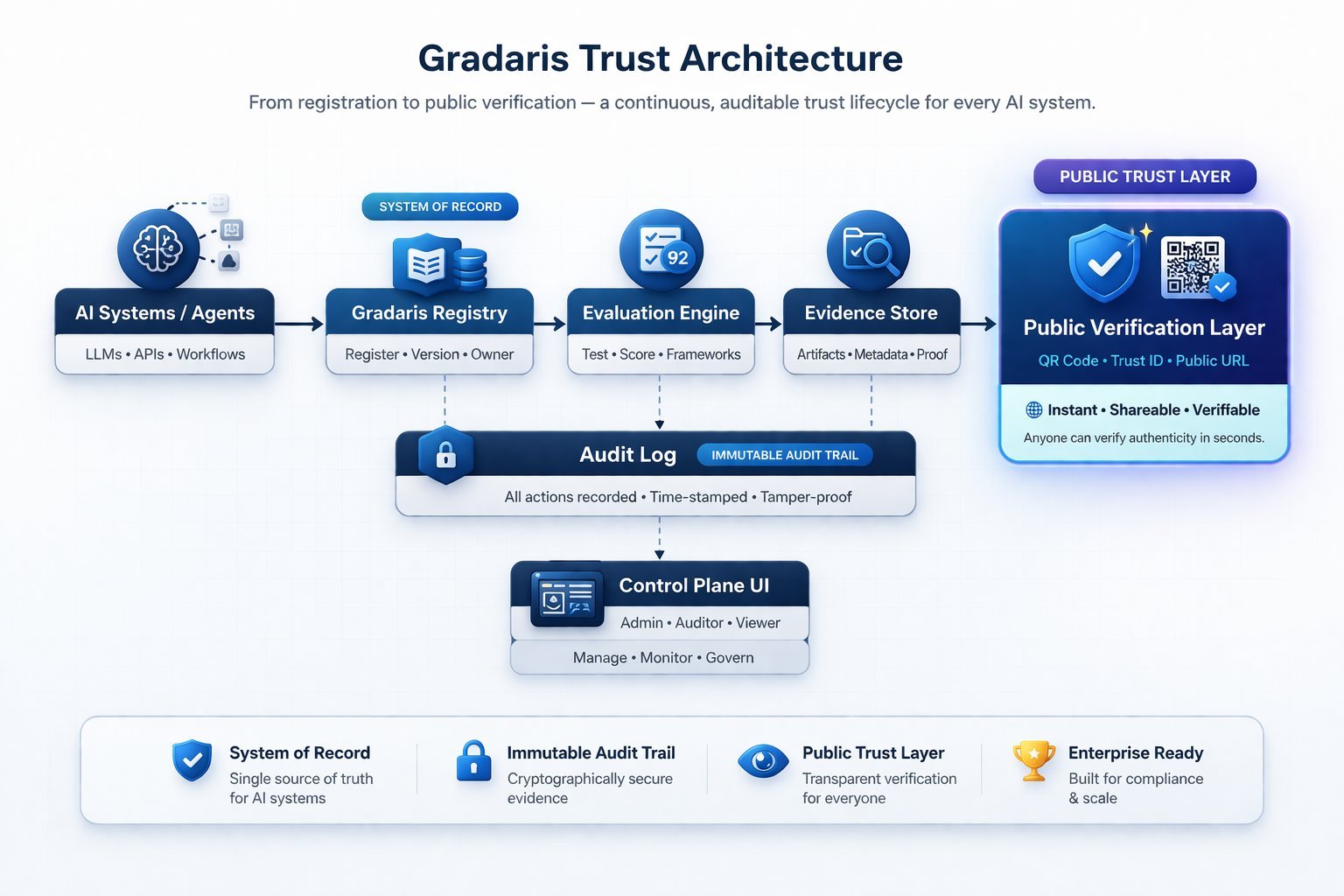
See how Gradaris registers, assesses, and verifies AI systems — turning regulatory requirements into auditable, regulator-ready evidence.
Up and running in under 30 minutes
Every AI system registered in Gradaris receives a unique Trust ID — a tamper-evident governance record linked to scoring, evidence, certification status, and public verification.
The EU AI Act creates real legal exposure. Most organizations aren't prepared — not because of the AI systems IT built, but because of the agents finance, marketing, and operations quietly created that nobody is tracking.
AI agents making business decisions without documented oversight or audit trails — creating silent liability.
Compliance teams unable to demonstrate conformity when regulators ask — no records, no defence.
Finance, HR, and marketing agents built outside IT visibility — impossible to govern what you can't see.
Gradaris connects to your AI agents however they were built, then continuously monitors and scores them against the EU AI Act and your own governance policies.
Engineers use the Python SDK. Power users use a webhook. Non-technical teams register through a plain-English form. All three paths produce the same governance record.
Every agent run generates telemetry. Gradaris scores it across 12 criteria in three tiers — Verified Controls, Empirical Benchmarks, and Structured Assessment — mapped to EU AI Act articles.
Each agent gets a Gradaris Governance Score (A–F), a cryptographically-signed evidence package, and a PDF report you can hand directly to a regulator or auditor.
The biggest governance gap isn't the AI systems IT controls — it's the agents everyone else built. Gradaris has a path for every creator.
Drop into any Python agent in minutes. Zero dependencies. Automatic fraud and bad-actor signal detection. Async telemetry — never slows your agent.
Built your agent in Make, Zapier, Power Automate, or n8n? Add one HTTP step and paste your webhook URL. No code required.
Finance, marketing, or accounting teams built an agent in ChatGPT or Copilot? Fill in a plain-English form. Gradaris creates the governance record automatically.
Every Gradaris Governance Score is more than a number. It comes with a tier breakdown, confidence levels, EU AI Act article mapping, and a cryptographic integrity hash — so you can defend it in front of any auditor.
Enterprise deployments scale based on AI estate complexity and regulatory scope. Every plan includes the full Gradaris governance platform, all three integration paths, and auditor-ready evidence exports. Pricing is tailored to your AI estate — book a demo to discuss what fits.
Three audiences, one problem — AI deployment outpacing the governance needed to defend it.
When a regulator asks which AI systems you operate, you need to answer in minutes. Gradaris gives you a live registry of every governed agent, mapped to EU AI Act obligations, with auditor-ready evidence on demand.
Governance can't be a bottleneck. The Gradaris Python SDK adds continuous monitoring in under an hour — async telemetry, zero external dependencies, automatic signal detection from data you're already logging.
The highest-risk agents are often the ones built outside IT — the ChatGPT workflow in finance, the Copilot agent in HR. Gradaris gives these teams a plain-English registration form. Five minutes, no technical knowledge required.
When an AI agent passes governance assessment, Gradaris issues it a unique Trust ID — publicly verifiable by anyone, no login required. Regulators, counterparties, and auditors can confirm governance status in seconds.
verify.gradaris.com/GRD-AI-YYYY-NNNNNNEvery Gradaris governance report embeds a QR code. Anyone — a regulator, auditor, or counterparty — can scan it and see live certification status. No login. No friction.
Everything you need to know about AI Trust IDs, scoring, certification, and the public registry.
An AI Trust ID is a unique identifier assigned to an AI system that links to its verified governance record. It provides a public, tamper-evident reference to that system's grade, certification status, and evaluation history.
Traditional tools focus on internal policy management and documentation. Gradaris adds an external verification layer — combining structured evaluation, scoring, certification, and a public trust registry. It functions as a system of record for AI governance, not just a workflow tool.
Gradaris is both. It performs structured evaluations that result in certification, and it supports ongoing reassessment to reflect changes in system behavior, controls, or risk posture over time.
Grades are calculated using a structured evaluation framework across multiple criteria, including governance controls, transparency, reliability, and operational safeguards. Each criterion contributes to a composite score, with certain high-risk gaps capping the overall grade.
No. Organizations provide inputs and evidence, but scoring is determined independently based on evaluation criteria. Results cannot be directly modified by the organization.
Systems can be re-evaluated on a defined cadence or when material changes occur — such as model updates, policy changes, or new risk signals. Grades are updated whenever a re-evaluation is completed, ensuring the published record reflects the current state of the system.
If a system no longer meets required standards, its grade and certification status may be updated, downgraded, or revoked. The public record always reflects the most current evaluation.
Revocation may occur due to significant control failures, loss of required safeguards, material risk exposure, or failure to maintain evaluation standards over time.
The public registry displays summarized results such as grade, status, and key attributes. Detailed internal evidence, sensitive configurations, and proprietary information are not exposed.
Gradaris does not assess business performance, financial outcomes, or non-AI operational processes. Its focus is on governance, risk, and trust characteristics of AI systems.
Gradaris is designed to minimize sensitive data exposure. Only required evaluation inputs and metadata are processed, and organizations maintain control over what is submitted.
Yes. Organizations can provide evidence and inputs without exposing sensitive internal details publicly. Public outputs are limited to verification-relevant information.
Gradaris can integrate through APIs and structured data inputs, enabling connection with existing governance, monitoring, and operational systems.
Gradaris aligns with industry-standard security practices and is designed to support frameworks such as SOC 2, NIST, and ISO-based controls. Security architecture emphasizes data protection, access control, and auditability.
Yes. Gradaris supports enterprise SSO via SAML 2.0, enabling integration with identity providers such as Okta, Azure AD, Google Workspace, and others. Administrators can configure and manage SSO directly through the admin portal, including role mapping, domain hints, and enforcement policies.
Book a 30-minute demo and we'll show you how quickly you can build a defensible AI governance program — even if your AI estate is already in production.